

My Personal Favourite

Ranking My Collection
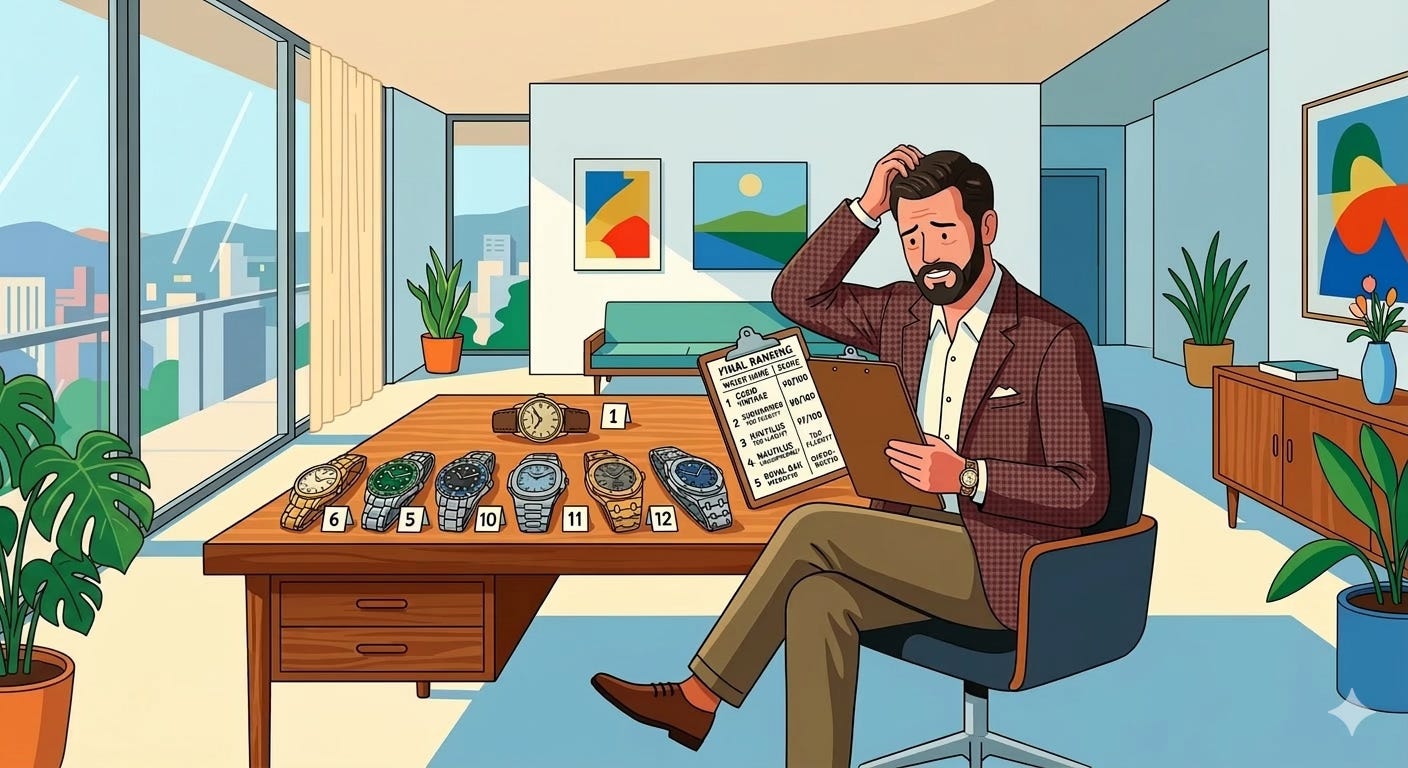
I recently tried ranking every watch in my collection.
The result was deeply inconvenient.
Only one of the watches I would have instinctively placed in my top five actually appeared there. One of the others ended in the bottom five. Which raises an uncomfortable question: how exactly do you rank a watch?
Refining the Collection
It has been far too long since I properly looked at my collection. I did very well selling nine pieces last year. Well, apart from the F.P. Journe that tripled in value after I sold it. However I have been procrastinating about going beyond the easy culls. So I am back with the same thought: How many of these do I actually need?
As collectors, we love to talk about new purchases. The hunt, the waiting lists, the lucky finds. What we talk far less about is pruning. Most mature collections eventually reach the same point: they grow faster than they evolve. And eventually you stop telling people how many watches you actually own. Collecting is fun. Explaining the size of the collection is less so.
Recently I found myself thinking about the management philosophy of Jack Welch, the famously hard-nosed leader of General Electric in the 1990s.
Welch had a brutally simple system. Each year all employees were ranked and the bottom 10% were let go. His belief was that organisations stagnate if they do not remove the weakest performers.
I am not suggesting that watches are employees. But the idea did make me wonder: what would happen if I applied the same thinking to my collection each year?
What if I forced myself to identify the bottom 10%? Not the cheapest. Not the least prestigious. Simply the ones that contribute the least to my collection as a whole.
That led me down an interesting rabbit hole: how exactly does one rank a watch?
Price clearly is not the answer. Some watches like my Patek Philippe 5078 rarely leave the safe, while humbler pieces end up on my wrist every week. Likewise, horological complexity alone is not enough. A technically brilliant watch can still leave you cold.
So, I started sketching out a scoring system. There is nothing scientific about it as it is far too subjective a subject. But I am hoping it is something structured enough to help me.
My Collector Scorecard
The idea is that each watch in the collection gets rated across several criteria. None of these on their own determine greatness, but hopefully together they paint a more accurate picture.
I eventually ended up with eleven criteria. Excessive perhaps, but collectors are rarely accused of restraint. And yes, there might be some overlap with some of the categories but bear with me.
1 Wrist Time: 10 Points
Probably the simplest measure. How often do I actually wear this watch?
I fear that as collectors, we often discover an uncomfortable truth here:
Some watches spend very little time on our wrists.
2 Emotional Pull: 10 Points
This is a lot harder to quantify, but I feel it is one of the most important.
The idea here is to ask: Do I still enjoy putting it on? Do I occasionally glance at it for no reason?
Some watches just make you smile. Like that cheesy grin you get every time you start a 911.
3 Design Longevity: 10 Points
Is the design timeless, or tied to a particular moment? Think stone dial hype, rose gold etc..
Some watches age like fine architecture. Others age like 1980s fashion.
4 Watchmaking Merit: 10 Points
This is the horological category. Movement architecture. Finishing. Technical interest. Historical significance.
Some watches simply carry more mechanical substance than others.
5. Versatility: 10 Points
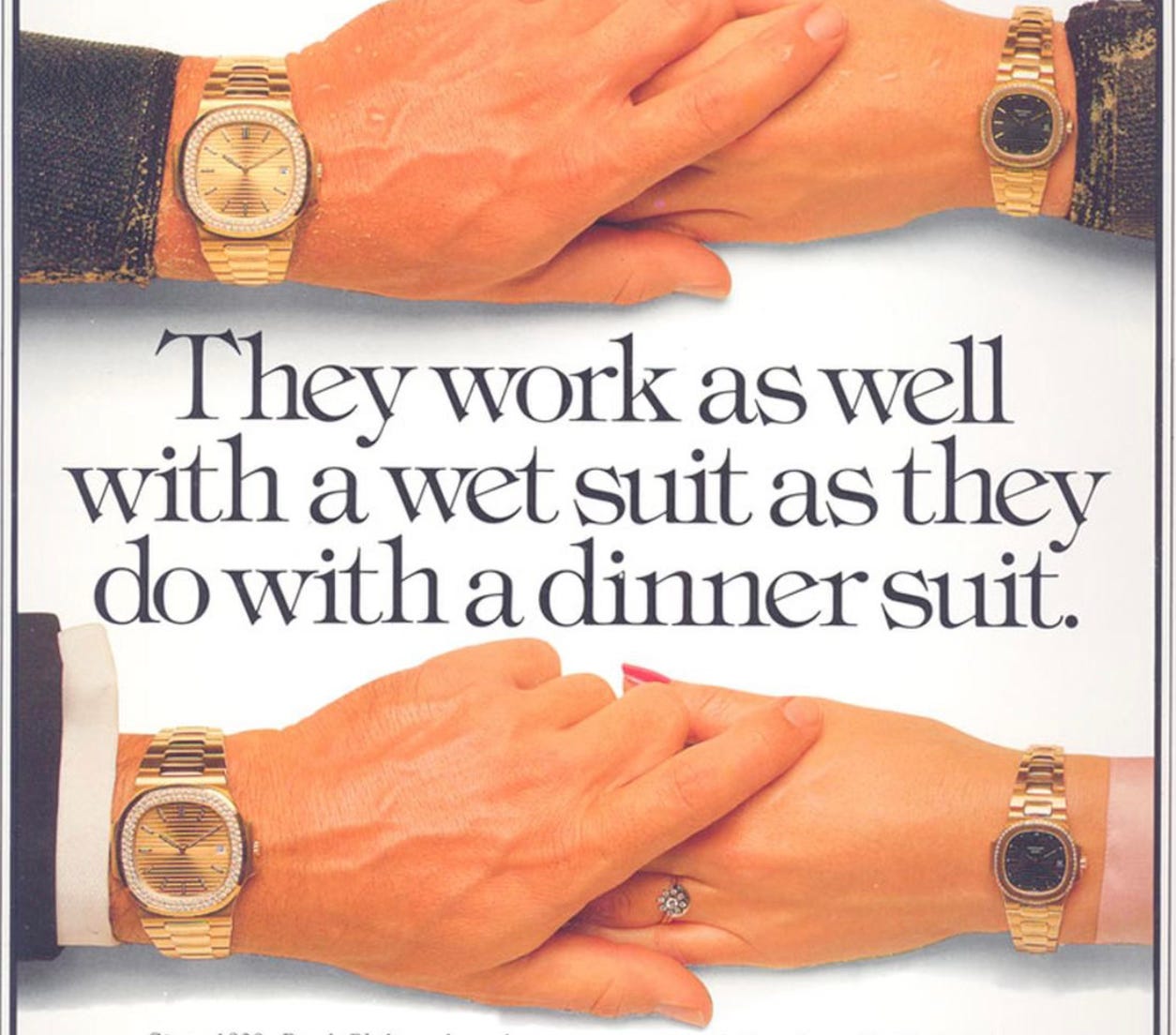
Can it work in multiple contexts? A watch that works with a suit, a jumper, and at a weekend lunch scores quite differently from one that only comes out for black tie events.
Some watches are far more versatile
6. Collection Role: 10 Points
Does the watch add something unique to the collection.
I fear we often discover that we own several watches that occupy the same space in the collection. How many dive watches does a non-diver need?
Some watches are duplicates in the collection.
7. Ownership Friction: 10 Points
Here the question is to assess how easy it is to wear and live with a watch. Does it require constant care? Is it very fragile ? Would a scratch ruin it?
Some watches are effortless companions. Others feel more like custody arrangements.
8. Story: 10 Points
Watches with unusual provenance or historical quirks tend to age well in a collection. We rarely tire of pieces with a narrative
Some watches tell a more interesting story.
9. Value v Wearability: 10 Points
This is where reality intrudes. Some watches are so valuable that you hesitate to wear them freely. The watch itself has not changed, but the psychology around it has.
Some watches shift from wrist companion to an asset under management.
10. Replicability: 10 Points
If I lost this watch tomorrow, how hard would it be to replace? Are there 500 on Chrono24 or none?
Some watches are expensive but common (eg a 5711A). Others are cheap, yet obscure and impossible to find again.
11. Would I still chase it: 10 Points
Ask yourself the very simple question. If I did not already own this watch, would I be hunting it? Many watches enter a collection during a particular phase and the key is to assess whether the curiosity that drove the purchase has evaporated or is still present.
Some watches are mot worth chasing twice.
The Brutal Part.
Having built the framework, I sat down one evening and scored every watch in the collection. This took far longer than I expected. Each category really forces you to stop and think: how often do I really wear this? Do I still feel the same excitement I did when I bought it? Would I actually hunt it down again?
A couple of hours later I had a list and I sorted the collection via its score. The result was surprising.
Only one of the watches I would have instinctively placed in my top five actually appeared there. The others had drifted further down.. with one ending up the bottom five.
My immediate reaction was not philosophical reflection. It was far less noble. My instinct was: the criteria I set must be wrong.
I had spent a good few hours constructing the framework, yet within seconds of seeing the result I was tempted to start adjusting the scoring categories until the “right” watches floated back to the top. After all, collectors are remarkably good at adjusting the rules until the right watch wins.
Of course, that rather defeats the whole point of the exercise.
Once you build a scoring system, subjective as it may be, you have to try and use it. I immediately noticed that the monetary value of a watch barely predicted its rank. That gave me a push to understand the results.
The Value Problem
The biggest surprise was how heavily monetary value influenced the rankings. Negatively.

Several of the watches I consider the centrepieces of my collection scored far lower than expected.
Not because of design. Not because of technical merit. But because of something more mundane: I simply don’t wear them freely any more.
At a certain price, a watch stops being carefree.
You become more conscious of where to go with it, who notices it, and what the ramifications are if something goes wrong.
Nothing has changed with the watch, but something has changed with the experience of owning it. When I scored honestly across categories like wrist time, versatility and wearability, value quietly drags the score down.
The irony is that the watches that collectors admire the most may actually be watches they enjoy the least. Well, that seems the case for me.
Best and Favourite are not the same
We often talk about our top pieces, but what this exercise revealed there are really two categories for me.
The watches I admire the most
And
The watches I actually enjoy the most
The overlap between the two is way smaller than I expected. The watches that ranked highest were not necessarily the most prestigious or valuable. Simply, the ones that combine emotional pull, wearability and design in a way that makes them effortless companions.
When you think about it, that is probably what watches are meant to be in the first place.
Now the obvious question: what would Jack Welch do?
What Happens next
The exercise revealed something I had not expected. There are two different types of categories in my collection. Whilst I was not really aware of this, it has certainly identified watches that will need to leave the collection.
Over on Instagram, I will be sharing the top five. I am reluctant to share the bottom five, as this might make selling them harder. All I will say now is, there is a hyped sports watch lurking at the very bottom. The top watch scored 93 out of 110. The lowest scored 34 out of 110.
I would love to hear your thoughts and how you would approach this process. Or perhaps I should just stick to being a hoarder?
An excellent exercise for any true collector (i.e. owner of way too many watches). I am trying to give your categories a go, but I am hesitant about assigning a maximum of 10 points to each item when I do not think that they have the same importance nor would the sum be more than a data point. Two examples: A) Family watches (Father's, Grandfather's) are both somewhat delicate and too precious to lose so equally get little to no wrist time and say for argument's sake (happily not the case) were neither of special technical merit or timeless design. I would still never willingly part with them, sentimentality is worth 100 points! B) Historical pieces. It means a lot to me to have examples from the 20th century developments, WWI, first purpose made lugs, interwar shapes, technical steps in waterproofness etc. etc. Most would score badly on many categories, but collection-wise are 100 points. Lastly a quibble on versatility: When you have a whole collection of pretty much every type of timekeeper let alone wristwatch, why would versatility ever matter for any given timepiece? Appreciate your thoughts, I already have my excel spreadsheet set up to give it a try!
Excellent set of criteria, and I found myself mentally evaluating my collection relatively efficiently as I read the post!
Definitely, I think it would be worth sitting down and doing it more formally although I can tell, right off the bat a couple that will end up at the bottom that I wouldn’t have imagined
The value issue! Yes! This finally explains exactly why I have been so reluctant to put on my CB and wear it anywhere the last 6-8 months!
Absolutely insane it’s apparent value now compared to the retail price I paid a few years ago being a small fraction of what they’re going for now.
Yet I wouldn’t feel good about “flipping” it as I was basically gifted with it by my AD when they were the last retail dealer to be cut off by FPJ when they exited the brick and mortar scene and I was offered the last one they would receive ahead of several dozen people on their own waiting list (they had been the first US dealer as well) …. Possibly it will mostly remain in the one of the watch boxes waiting for the next generation. 🙆🏼🤷🏼🤦🏼
Great post!